SuperFolder DarthZackB
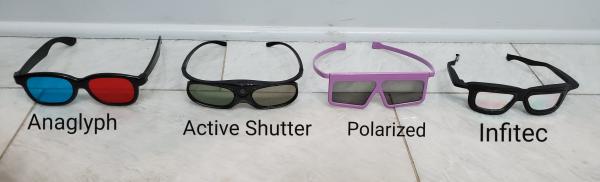
Here is a demonstration of the different types of 3D glasses.
Anaglyph 3D glasses are traditional and have red/cyan lenses, but different colored lenses include green/magenta and blue/yellow. They have a low price and no need for any special screen, but they offer low 3D quality, which is why it is no longer used in theaters today.
Active shutter 3D glasses, used for 3D TVs, PCs, and projectors, have a liquid crystal display (LCD) and often use a DLP link. They have a good 3D effect, but they are expensive and not very comfortable. And they sometimes flicker, which causes mild dizziness.
Polarized 3D glasses, like the ones from “Muppet*Vision 3D” at Disney’s Hollywood Studios, have two styles: linear and circular. With linear polarized 3D glasses, you can’t tilt the head, but the more common style, circular polarized, allows tilting the head. Polarized 3D glasses have a good 3D effect, but is decreased compared to the active shutter 3D glasses. They are cheaper and comfortable, but require a silver screen when using a projector, which makes the system more expensive.
Infitec (Interference Filter Technology) 3D glasses, like the ones from “Star Tours – The Adventures Continue” at Disney’s Hollywood Studios and Disneyland Park, are nicknamed “Super Anaglyph”, because they have a good 3D effect. They are also complicated to set up at home, and they are used mostly in cinemas and theme park rides.
To view a 3D movie at home, you need a 3D television display, 3D glasses, a Blu-ray 3D player, and a high speed HDMI 1.4 cable. “Avatar” will be the first movie to watch on Blu-ray 3D. I will also watch “Titanic” on Blu-ray 3D. Both these movies are directed by James Cameron and certified by THX.